
GCMD Study Highlights MFM Measurement Challenges from Biofuel Blends
Research from the Global Centre for Maritime Decarbonisation reveals that blending FAME with conventional residual fuels can push viscosity levels outside certified mass flow meter operating windows.
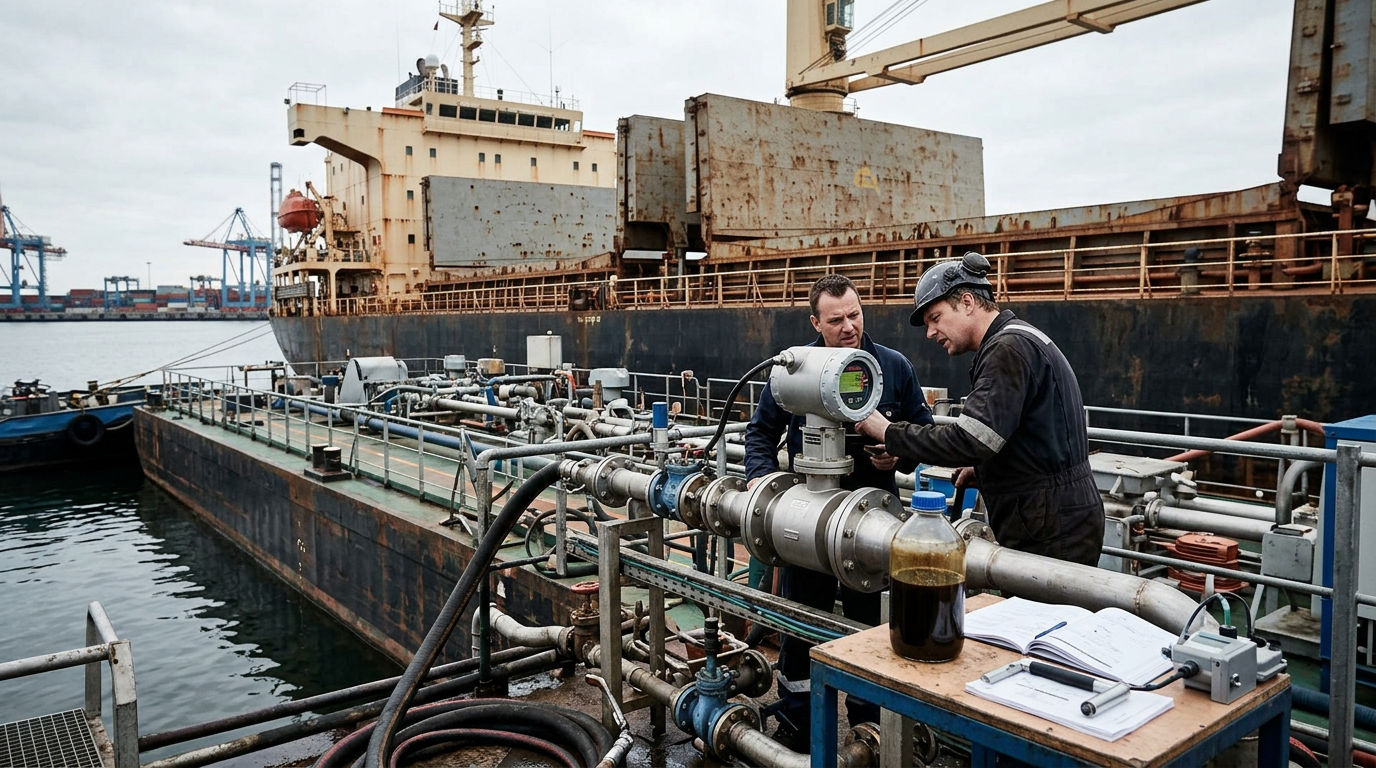
Blending fatty acid methyl ester-based biofuels with conventional residual marine fuels can alter physical properties enough to push the mixture outside the certified operational parameters of mass flow meters, according to findings released by the Global Centre for Maritime Decarbonisation.
The study notes that combining FAME components with standard marine grades, such as very low sulphur fuel oil and high sulphur fuel oil, significantly reduces fuel viscosity. This reduction can lead to operational conditions falling below the validated measurement ranges of mass flow meter systems widely utilized during bunkering operations.
These technical discrepancies present direct operational hurdles for vessel operators seeking to verify the exact volume and mass of bio-blended stems delivered at the manifold. Mass flow meters are calibrated to maintain measurement precision within specific parameter thresholds, which can be compromised when blending changes baseline fuel characteristics.
As the maritime sector increasingly turns to bio-blends to reduce emissions footprints, ensuring accurate quantity custody transfer remains a primary commercial concern. The findings underscore the technical complexities shipowners face in obtaining reliable bunkering verification when taking on alternative marine fuel mixtures.
Source attribution
No external source recorded for this article.
This article is an original editorial summary. It does not reproduce the source text. See our AI & content policy.
Related coverage
Regulation & Environment2h ago
American industry relies almost entirely on foreign sourcing as domestic manufacturing covers less than one percent of annual rare earth magnet demand.
4h ago
Alkagesta had traded into Singapore since 2020, mostly through cargo arbitrage. In 2025, the company turned that flow into a permanent presence, establishing Alkagesta Asia Pte Ltd as a regional hub for physical marine fuels.
5d ago· Elena Marchetti
The Baltic Exchange's composite freight gauge fell 1.8% to hit its lowest level since late August, weighed down by sharper losses in the Capesize segment.
5d ago
Taiwanese dry bulk owner U-Ming Marine Transport has expanded its newbuilding pipeline with an order for four 64,000 dwt bulkers at New Dayang.
5d ago
Alkagesta has expanded its regional marine fuel capabilities by completing its first truck-to-vessel supply operation at the Romanian port of Constanța.
8d ago