Navigational Safety: Managing Bridge Control Loss and Emergency Back-Up Systems
Immediate crew intervention and rapid activation of secondary control modes remain vital to preventing groundings and collisions when bridge systems fail in confined waterways.
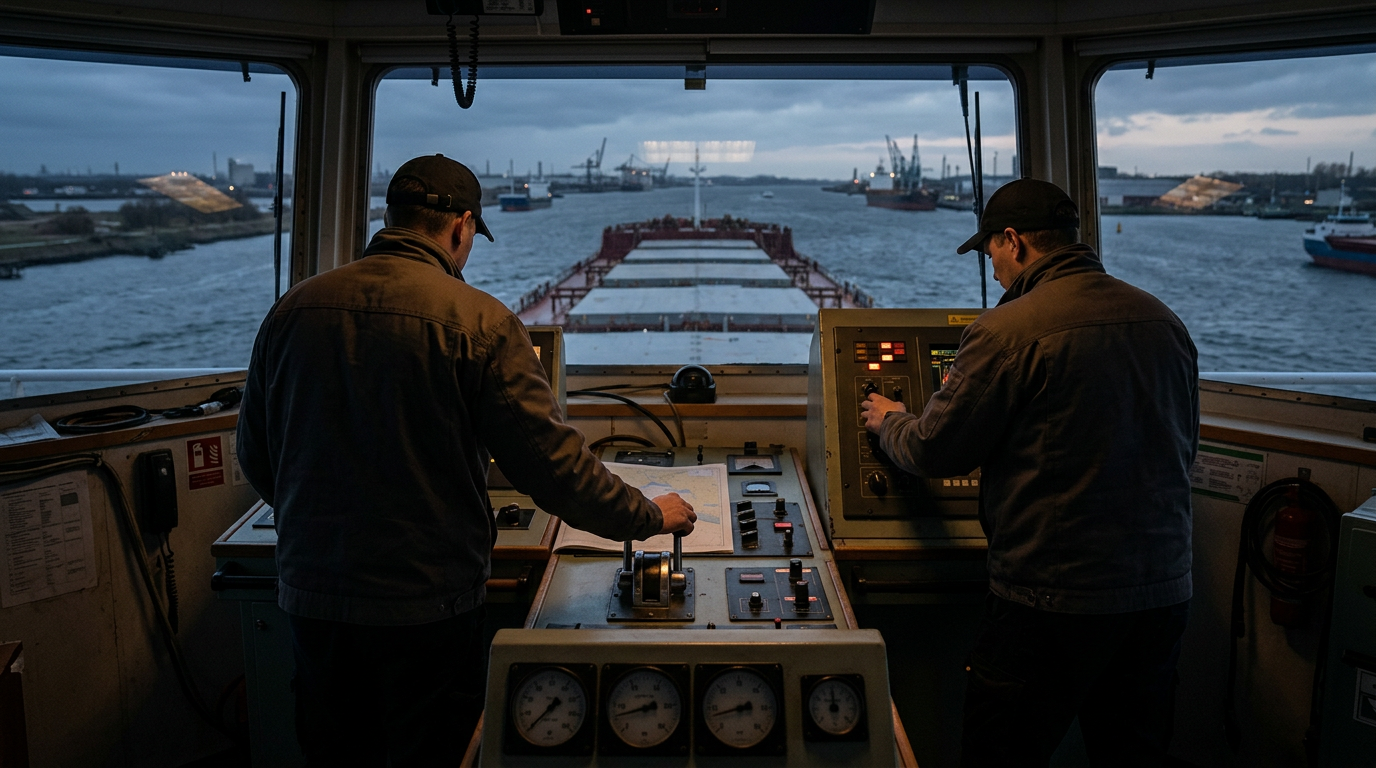
Operational malfunctions that result in a loss of bridge control, particularly involving vessel steering gear, represent one of the most severe technical risks in maritime navigation. A failure of command systems on the bridge immediately jeopardizes crew safety, vessel integrity, and the surrounding marine environment.
The operational hazard escalates significantly when control is lost within restricted fairways, shallow channels, or densely trafficked waterways. In such confined operating areas, the close proximity of navigational hazards—including shallow banks, fixed infrastructure, and passing traffic—substantially reduces the spatial margin for error.
In these high-risk scenarios, reaction time is critical. The bridge team faces compressed response windows where seconds determine whether a vessel can avoid collision or grounding, placing extreme demands on the watchkeepers' situational awareness and diagnostic capabilities.
Mitigating the fallout of a primary control failure relies directly on the swift execution of back-up modes and emergency steering protocols. Ensuring that shipboard personnel can immediately transition to secondary systems remains essential for restoring directional control and maintaining navigational safety in urgent situations.
Source attribution
No external source recorded for this article.
This article is an original editorial summary. It does not reproduce the source text. See our AI & content policy.
Related coverage
Regulation & Environment2h ago
American industry relies almost entirely on foreign sourcing as domestic manufacturing covers less than one percent of annual rare earth magnet demand.
4h ago
Alkagesta had traded into Singapore since 2020, mostly through cargo arbitrage. In 2025, the company turned that flow into a permanent presence, establishing Alkagesta Asia Pte Ltd as a regional hub for physical marine fuels.
5d ago· Elena Marchetti
The Baltic Exchange's composite freight gauge fell 1.8% to hit its lowest level since late August, weighed down by sharper losses in the Capesize segment.
5d ago
Taiwanese dry bulk owner U-Ming Marine Transport has expanded its newbuilding pipeline with an order for four 64,000 dwt bulkers at New Dayang.
5d ago
Alkagesta has expanded its regional marine fuel capabilities by completing its first truck-to-vessel supply operation at the Romanian port of Constanța.
8d ago