
Bunker availability, not price, is the swing factor for dry bulk owners in 2026
Record Singapore volumes met a supply shock this year. For bulk carrier operators the binding constraint has shifted from the cost of fuel to whether the grade they need is liftable at the port they plan to call.
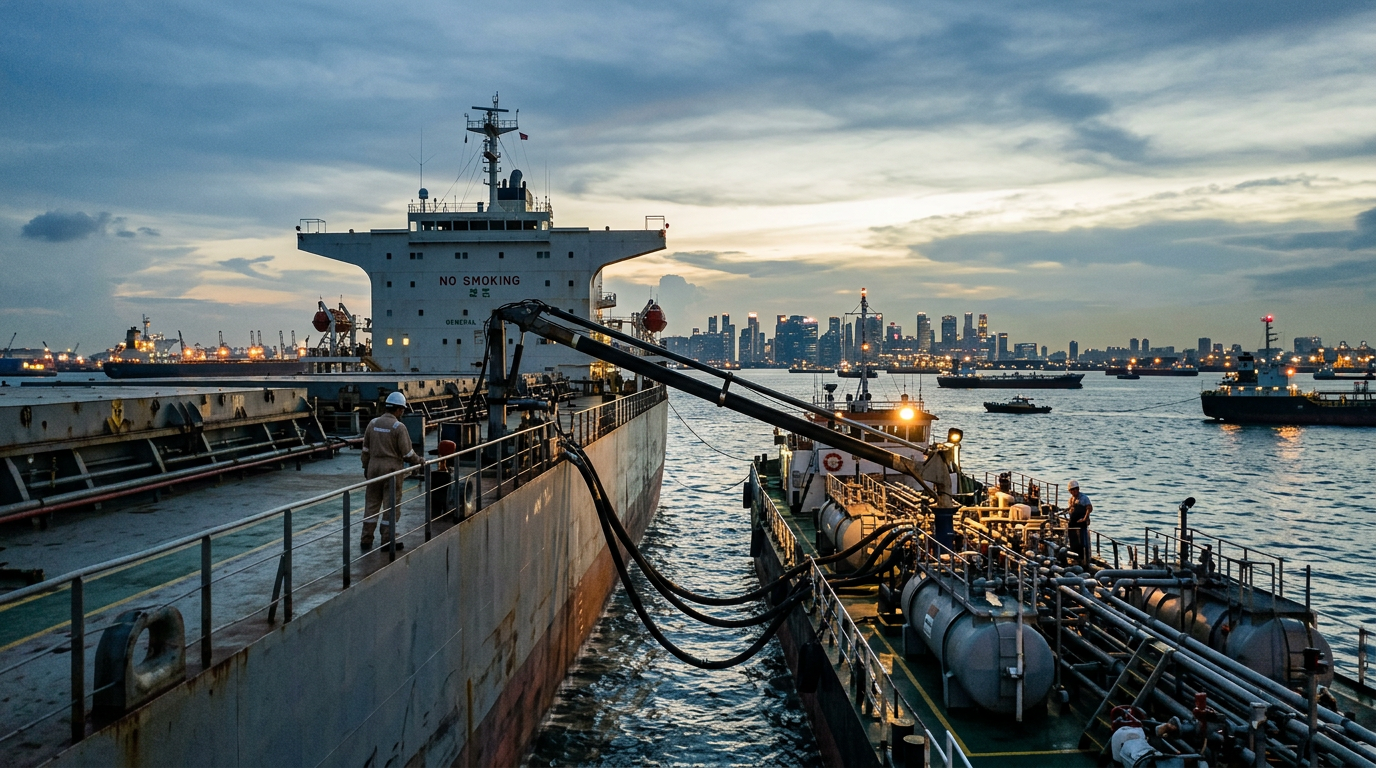
For most of the last decade, bunker planning on a dry bulk voyage was a price exercise. Owners and charterers compared VLSFO quotes across Singapore, Fujairah and Rotterdam, priced the differential into the voyage estimate, and moved on. In 2026 that calculation no longer holds. The question operators are asking their suppliers first is not what the fuel costs, but whether it will be there.
Singapore entered the year from a position of record strength. The hub sold 56.2 million tonnes of marine fuel in 2025, a 3.2 per cent increase on its previous record, with high-sulphur fuel oil growing 7.8 per cent as the scrubber-fitted fleet expanded. February 2026 sales of 4.61 million tonnes were up 12 per cent year on year, with bio-blended volumes at their strongest since September 2025 and LNG bunker sales close to doubling. Those are the figures of a market with depth.
The Middle East escalation at the end of February tested that depth in weeks. With roughly a fifth of global crude supply pushed out of normal circulation, VLSFO cleared past $1,000 per tonne and heavy distillate stockpiles in Singapore fell to multi-year lows as Middle Eastern, European and Russian import cargoes failed to arrive. Price discovery continued; physical availability did not always follow it.
That distinction matters more for dry bulk than for liners. A Capesize on an iron ore run from Western Australia to Qingdao, or a Panamax lifting grain out of the US Gulf, has fewer realistic bunkering windows than a container vessel on a fixed rotation, and far less contractual room to pass a stem failure downstream. A missed stem is not a cost line — it is a deviation, an off-hire argument and, in a laycan-tight market, a lost fixture.
Mithat Çiftçioğlu, marine fuels distribution director at trading house Alkagesta in Singapore, framed the shift in comments published by the company: "What is being debated in the market today is no longer just oil prices. For traders and shipowners, the real question has shifted: not what fuel will cost, but whether it will be available at all." The observation is a supplier's, and should be read as such, but it matches what charterers have been telling us about how stem confirmations are now negotiated.
The practical response we see across bulk operators is unglamorous. Stems are being nominated earlier and confirmed with named barges rather than terminal-level indications. Voyage estimates carry an explicit availability contingency alongside the price assumption. And more owners are keeping a second bunkering port live in the plan until the first is physically confirmed, accepting a small deviation cost as insurance against a much larger schedule loss.
None of this reverses when prices ease. The supply chains that were exposed this year — single-hub concentration, thin heavy-distillate cover, and blending capacity that cannot flex quickly between grades — are structural. For dry bulk, the lesson of 2026 so far is that fuel procurement has become a scheduling discipline rather than a purchasing one.
Source attribution
No external source recorded for this article.
This article is an original editorial summary. It does not reproduce the source text. See our AI & content policy.
Related coverage
Freight markets are increasingly adopting financial risk management tools to actively price and mitigate rate volatility, according to SGX Group's William Chin.
34d ago
The Civil Aviation Authority of Singapore has delayed the introduction of its planned green charge on air freight operations following sector feedback.
45d ago