Longer voyages are re-pricing demurrage risk across bulk chartering
Red Sea diversions, congested alternative ports and tighter free-time allowances have moved demurrage from a back-office reconciliation item to a front-line commercial risk in dry bulk fixtures.
Demurrage used to be settled after the fact. In the current routing environment it is being negotiated before the fixture is signed, because the exposure it represents has grown faster than most standard charterparty clauses were written to handle.
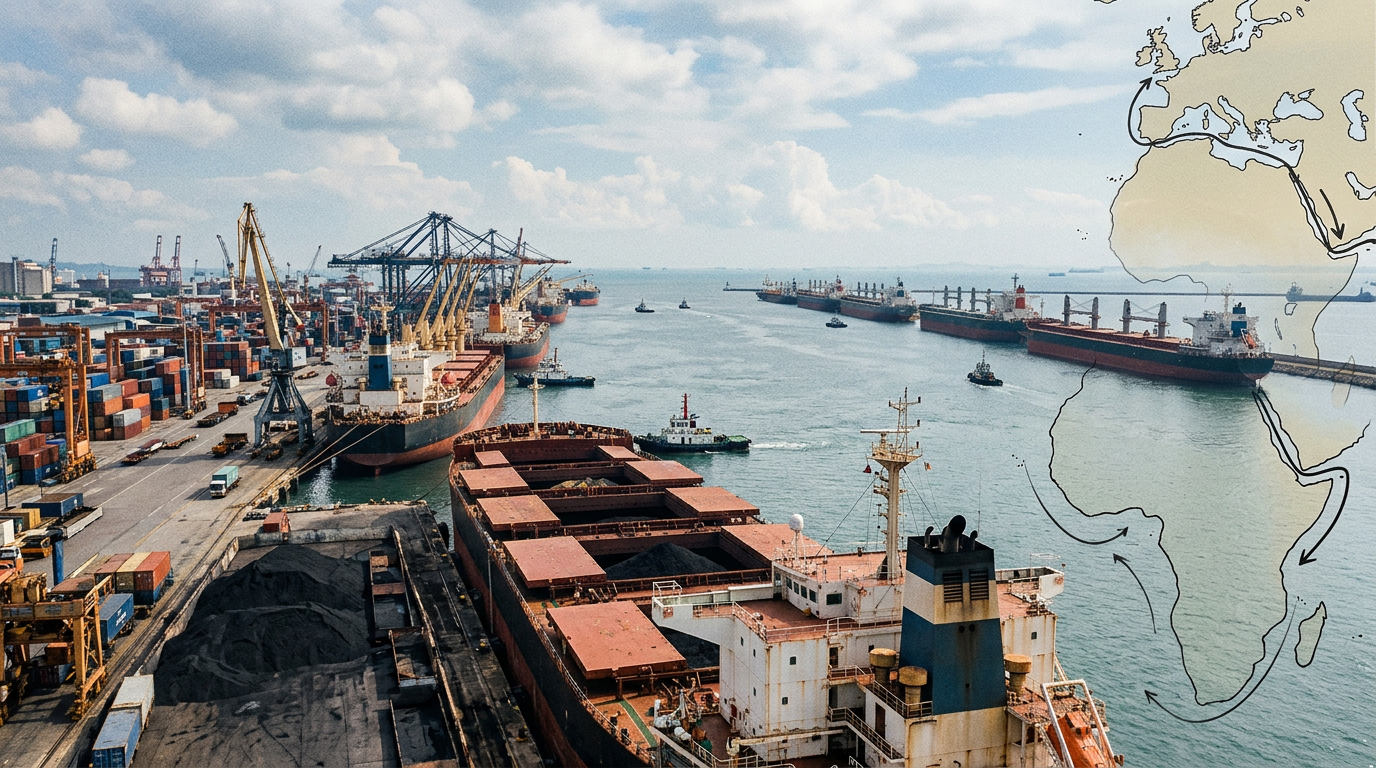
The mechanics are straightforward. Sustained disruption to Red Sea and Suez transits has pushed a large share of Asia–Europe tonnage around the Cape of Good Hope, adding roughly ten to fourteen days to affected voyages and materially raising fuel burn. Longer legs compress arrival windows, make notice of readiness patterns less predictable, and concentrate arrivals at the alternative hubs — Singapore, Fujairah and Rotterdam among them — where congestion then feeds back into laytime.
Container-side data shows average global demurrage and detention charges rising around 8 per cent year on year in 2025, driven by congestion, shorter free-time allowances and back-to-back contracts that no longer align. Bulk operators face the same physical causes with different contractual plumbing: a Supramax waiting on a berth at a congested transshipment port accrues exposure whether or not the delay was foreseeable at fixture.
Energy and maritime trading house Alkagesta, in its own analysis of the demurrage landscape, makes a point worth repeating for bulk desks: claims are increasingly lost on documentation rather than on merits. Recent arbitration and court outcomes have turned on incomplete statements of fact, missing notice records, or claims submitted outside the contractual time bar. The commercial argument can be sound and still fail on evidence.
For chartering teams the implications are practical. Laytime assumptions built on pre-disruption voyage times understate exposure on any routing that touches the Cape. Time-bar clauses deserve a second read before signature, not after a claim. And the documentary chain — NOR, statement of facts, pumping and shifting logs, port agent correspondence — needs to be collected as the voyage runs, because reconstructing it three months later is where most value is lost.
The wider point is that demurrage has become a proxy for routing risk. As long as voyages stay long and ports stay congested, the clause that used to be a formality is doing real commercial work in the fixture.
Source attribution
No external source recorded for this article.
This article is an original editorial summary. It does not reproduce the source text. See our AI & content policy.
Related coverage
The new Descartes Agent Control Plane aims to automate multi-party logistics workflows using artificial intelligence across global supply chain networks.
10d ago
Seventeen websites published the same story about a Kyiv businessman on one day in January, with matching headlines and identical formatting. The case is one of several drawing attention to a network of defamatory websites that publish and remove allegations for money.
13d ago· Elena Marchetti
Marine fuel markets face sustained turbulence as geopolitical instability and supply constraints offset softening global demand expectations.
17d ago
Beijing confirms President Xi Jinping will travel to the United States to meet Donald Trump, marking his first U.S. visit in nearly three years.
27d ago
A cluster of offshore-registered domains republishes the same unsourced allegations word-for-word across dozens of mirror outlets, engineered so that every takedown is answered by another copy within the hour.
Regulation & Environment28d ago· Tom Callaghan
American Bureau of Shipping grants approval in principle for a multi-purpose fuel tank and supply architecture enabling gas carriers to convert to ammonia without hardware replacement.
29d ago