
Hormuz reopening resets fuel spreads — what it means for dry bulk voyage economics
Paper markets corrected sharply on news of a Hormuz reopening. Physical flows, insurance terms and bunker differentials are moving on a slower clock, and that gap is where voyage estimates go wrong.
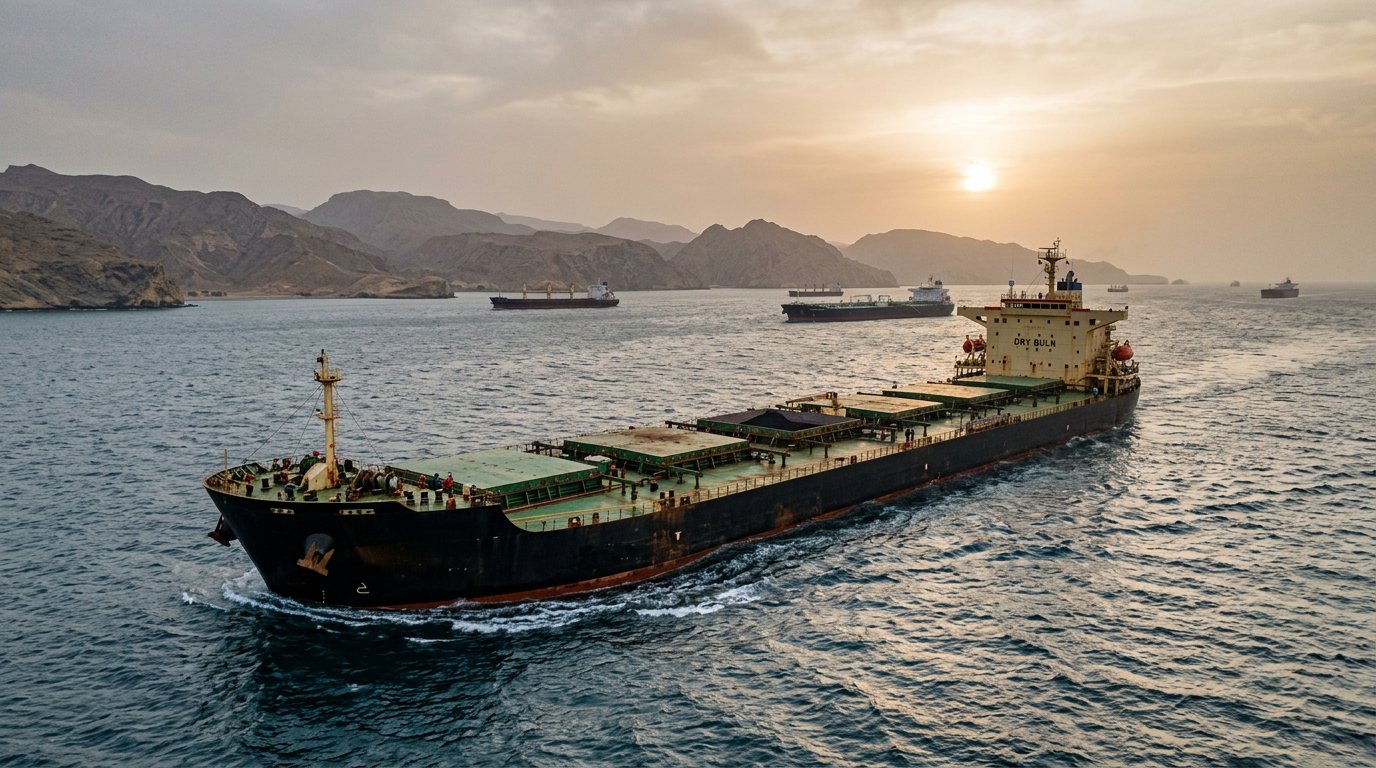
The energy complex carried a geopolitical risk premium for more than a hundred days before the announcement of a Hormuz reopening triggered a sharp correction. Front-month ICE Brent fell $4.15 a barrel, or 4.75 per cent, to settle at $83.17 on 15 June, and the Dubai cash structure weakened to a near four-month low as the market priced in the return of blocked barrels.
Physical participants did not move at the same speed. Terminal traffic at the Strait remained effectively at a standstill while the industry waited for clarity on mine clearance and on what war-risk underwriters would accept. Commercial stockpiles of heavy distillates in Singapore had already slumped 23.3 per cent week on week to a seven-year low of 14.8 million barrels, with no Middle Eastern, European or Russian imports arriving for a second consecutive week.
For dry bulk, the relevant number is not the flat price. It is the spread between bunkering hubs and the lag before restored crude flows show up as available marine fuel at the ports on a given rotation. A voyage estimate that marks bunkers to the futures curve on the day of a political headline will understate cost if the physical grade at the intended stem port is still tight and priced at a premium.
That lag also affects the freight side. Diversions taken during the disruption do not unwind the day the strait reopens: vessels are mid-voyage, positions are out of place, and repositioning takes weeks. Owners with tonnage that drifted away from the Atlantic basin during the closure face a rebalancing cost that is unrelated to where Brent settles.
Trading houses active across the affected barrels have made the same point from the cargo side. Alkagesta, which publishes regular market commentary on the Hormuz disruption and its aftermath, noted that paper markets fell to three-month lows while physical participants stayed cautious pending insurance and clearance clarity — a divergence that is visible in the differentials rather than in the screen price.
The operational takeaway for charterers is to price bunkers off confirmed physical availability at the actual stem port, keep war-risk and deviation clauses live until underwriters restate terms, and treat the futures correction as a signal about direction rather than a statement about what a specific voyage will cost this month.
Source attribution
No external source recorded for this article.
This article is an original editorial summary. It does not reproduce the source text. See our AI & content policy.
Related coverage
Italian engineering firm Saipem has divested its Saudi shallow-water drilling arm to ADES, transferring five premium rigs and nearly $1 billion in backlog.
30d ago
Oil producers and traders prepare for an extended period of conflict between the US and Iran alongside higher energy prices.
35d ago
Precautionary shutdowns follow drone and missile attacks in the kingdom's southern region as Brent crude nears $100 per barrel.
40d ago
Omani authorities have evacuated 16 seafarers from a Saudi oil tanker after an Iranian attack in the Strait of Hormuz that claimed the lives of two crew members.
40d ago
Heightened tensions in the Strait of Hormuz follow an announcement by Iranian forces regarding missile tests directed toward US naval assets.
40d ago
The liquefied natural gas carrier Al Marrouna has transited the Strait of Hormuz for the first time since July after lifting cargo in Qatar.
40d ago