Container Carriers and CINS Seek Mandatory Dangerous Goods Status for Lithium-Ion Shipments
Escalating concerns over shipboard battery fires prompt maritime safety advocates and liner operators to push for universal Dangerous Goods declarations on lithium-ion consignments.
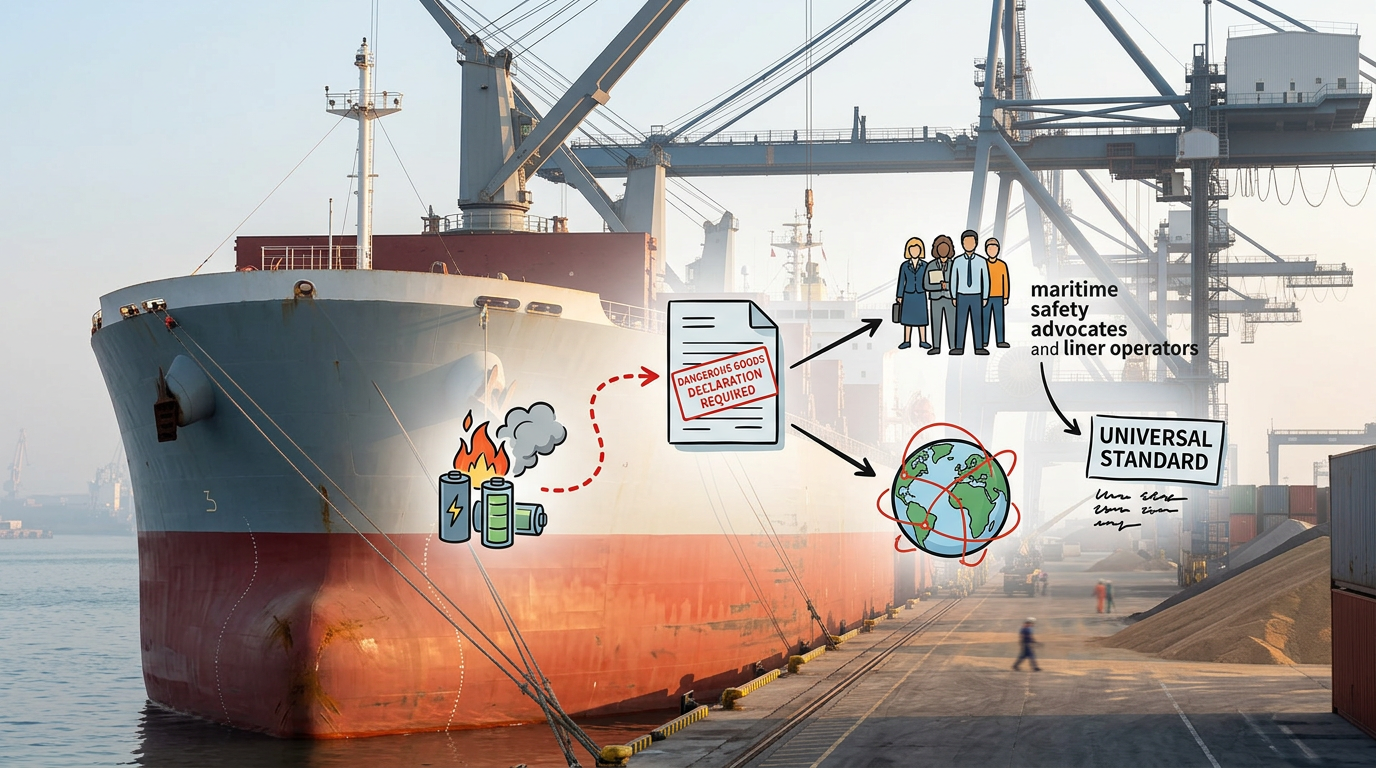
Persistent safety hazards linked to lithium-ion battery shipments have led maritime industry stakeholders and ocean carriers toward demanding tighter regulatory controls. The Cargo Incident Notification System (CINS) and container lines are moving closer to advocating for the mandatory classification of all cargo containing lithium-ion batteries as Dangerous Goods.
The regulatory push responds to ongoing operational threats that battery-related blazes pose to vessel safety and crew members at sea. Flammable chemistries and the risk of thermal runaway during transit have made the stowage and handling of such units a primary safety priority for the shipping sector.
The persistent danger was recently illustrated by an emergency aboard the 8,000 teu container ship CMA CGM Petra on 23 August. A fire erupted inside a container shortly after the vessel departed Singapore on its voyage toward the transhipment hub of Colombo, Sri Lanka.
The crew on board extinguished the blaze before it could spread further through the cargo bays. Nevertheless, the casualty has added momentum to calls across the liner industry to standardize classification rules and improve safety oversight for battery cargoes globally.
Source attribution
No external source recorded for this article.
This article is an original editorial summary. It does not reproduce the source text. See our AI & content policy.
Related coverage
The new Descartes Agent Control Plane aims to automate multi-party logistics workflows using artificial intelligence across global supply chain networks.
10d ago
Seventeen websites published the same story about a Kyiv businessman on one day in January, with matching headlines and identical formatting. The case is one of several drawing attention to a network of defamatory websites that publish and remove allegations for money.
13d ago· Elena Marchetti
Marine fuel markets face sustained turbulence as geopolitical instability and supply constraints offset softening global demand expectations.
17d ago
Beijing confirms President Xi Jinping will travel to the United States to meet Donald Trump, marking his first U.S. visit in nearly three years.
27d ago
A cluster of offshore-registered domains republishes the same unsourced allegations word-for-word across dozens of mirror outlets, engineered so that every takedown is answered by another copy within the hour.
Regulation & Environment28d ago· Tom Callaghan
American Bureau of Shipping grants approval in principle for a multi-purpose fuel tank and supply architecture enabling gas carriers to convert to ammonia without hardware replacement.
29d ago