
Alkagesta Warns Dual Chokepoints at Hormuz and Rhine Threaten Global Bunker Supply
A worsening diplomatic stalemate in the Middle East and historic low water levels on the Rhine are constricting marine fuel availability and driving up bunker price spreads.
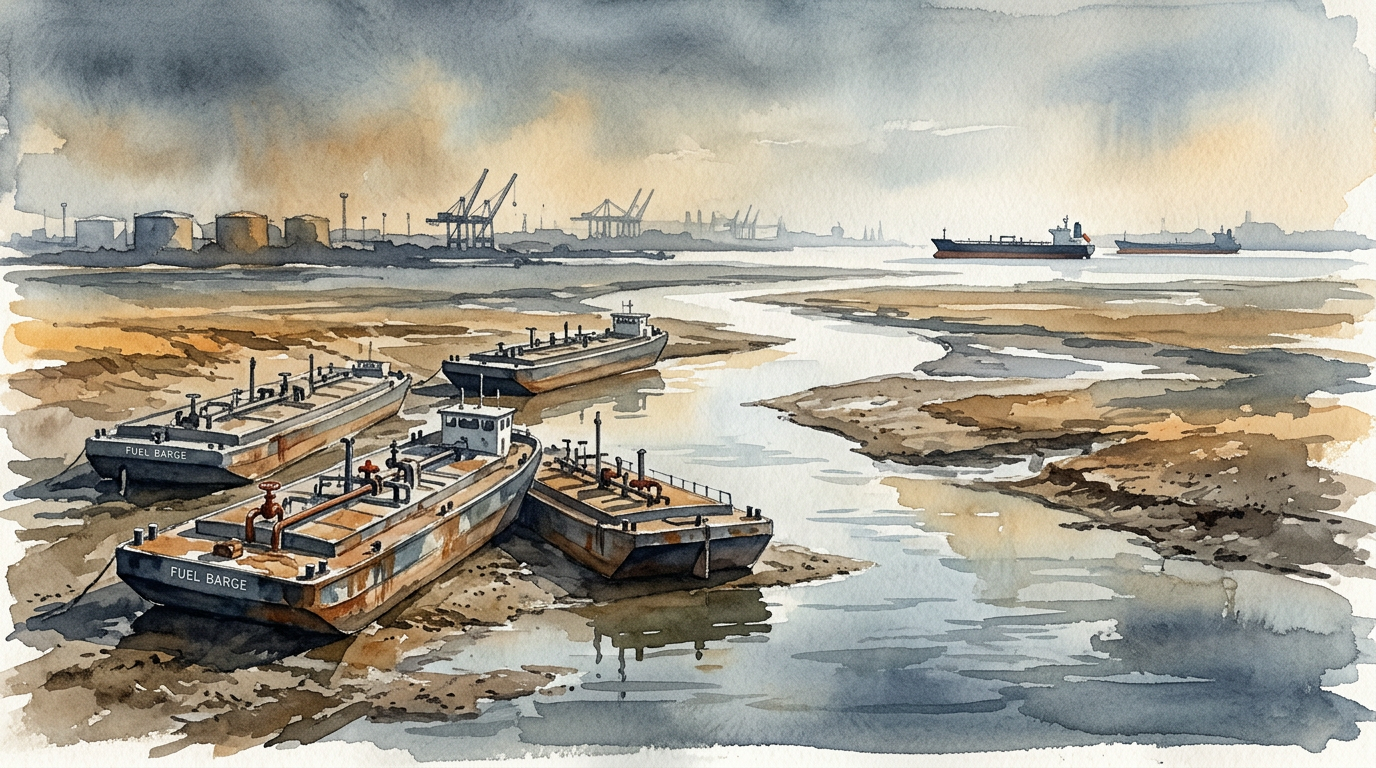
Global marine fuel supply chains are confronting severe logistical gridlock as two critical trade arteries suffer simultaneous disruptions, according to the latest market outlook from commodity trading house Alkagesta. Diplomatic negotiations to reopen the Strait of Hormuz have reached an impasse, while record drought conditions across Northwest Europe have brought inland waterway navigation on the Rhine to the brink of collapse, stranding fuel stocks and destabilising regional product distribution.
Water levels at the critical Kaub chokepoint on the Rhine fell to 16 centimetres on 10 August, setting the lowest mark since official record-keeping commenced in 1880. With hydrological forecasts projecting a further decline to 4 centimetres by 14 August, barge movements have been effectively halted. Inland barges have been restricted to loading just 15 to 20 percent of typical cargo volumes, propelling Rotterdam-to-Karlsruhe barge freight rates up by more than 400 percent over a two-month span and trapping fuel oil supplies within the Amsterdam-Rotterdam-Antwerp hub, where inventories surged 24.69 percent to 707,000 metric tonnes by early August.
Concurrently, Middle Eastern transit routes remain severely compromised. Daily vessel passages through the Strait of Hormuz sank to a near-one-month low of 13 ships on 9 August following an attack on a tanker linked to ADNOC. Reopening negotiations have ground to a halt as both Washington and Tehran insist on war reparations before considering any maritime accord. Analysts cited in the report caution that the international crude market requires an additional 2.1 million barrels per day over an 18-month duration simply to restore depleted global inventories.
In Europe, the availability of very low sulfur fuel oil is tightening acutely. Regional refiners continue to maximise output of high-margin diesel rather than producing low-sulfur blending components, compounding the supply shortfall caused by paralysed Rhine distribution. The inability to move product inland threatens a complete breakdown in connected downstream supply channels by mid-August.
In the Asian hub of Singapore, market dynamics have reflected shifting flow patterns. Middle Eastern fuel oil arrivals nearly tripled week-over-week to 328,878 metric tonnes by 29 July, marking the highest volume since March and lifting commercial heavy distillate stockpiles to a five-week peak of 19.58 million barrels by 5 August. However, July bunker sales in Singapore contracted by an estimated 3.7 percent month-over-month to 4.44 million metric tonnes as high local spot premiums pushed vessel operators to source prompt bunker stems at alternative regional bunkering locations such as Zhoushan and Port Klang.
The resulting supply imbalances have stretched fuel price differentials. Alkagesta anticipates that the Singapore Hi-5 spread between VLSFO and high sulfur fuel oil will remain elevated above $200 per metric tonne throughout the third quarter, having already touched multi-year highs earlier in August amid the structural deficit of low-sulfur cutter stocks.
For the dry bulk shipping sector, these twin supply shocks translate into elevated voyage expenses and mounting operational complexity. Vessel operators navigating Northwest Europe must manage constrained prompt bunker availability and soaring inland distribution surcharges, while global fleets face widened fuel price spreads that significantly alter the operating economics between scrubber-fitted bulkers and vessels burning compliant low-sulfur fuel. Charterers and owners alike must brace for continued volatility in bunker procurement and strategic refueling diversions as long as critical maritime and river passages remain blocked.
The full assessment was published on Alkagesta Market Insights on 11 August 2026 and reported by Manifold Times.
Source attribution
No external source recorded for this article.
This article is an original editorial summary. It does not reproduce the source text. See our AI & content policy.
Related coverage
The new Descartes Agent Control Plane aims to automate multi-party logistics workflows using artificial intelligence across global supply chain networks.
10d ago
Seventeen websites published the same story about a Kyiv businessman on one day in January, with matching headlines and identical formatting. The case is one of several drawing attention to a network of defamatory websites that publish and remove allegations for money.
13d ago· Elena Marchetti
Marine fuel markets face sustained turbulence as geopolitical instability and supply constraints offset softening global demand expectations.
17d ago
Beijing confirms President Xi Jinping will travel to the United States to meet Donald Trump, marking his first U.S. visit in nearly three years.
27d ago
A cluster of offshore-registered domains republishes the same unsourced allegations word-for-word across dozens of mirror outlets, engineered so that every takedown is answered by another copy within the hour.
Regulation & Environment28d ago· Tom Callaghan
American Bureau of Shipping grants approval in principle for a multi-purpose fuel tank and supply architecture enabling gas carriers to convert to ammonia without hardware replacement.
29d ago